Most fintech apps do not have an acquisition problem. They have an onboarding funnel that quietly loses half its signups before those users ever do anything valuable, and almost all of that loss happens in one place: KYC.
I spent years owning onboarding and KYC funnels in Indian fintech, including the work that took one platform from 0.2 million to over 1.3 million users. The pattern is remarkably consistent across companies, and the published data agrees. Signicat's Battle to Onboard study found that 68 percent of consumers have abandoned a financial services application mid-onboarding. The top of the funnel looks fine: installs are healthy, signups are healthy, and then a cliff appears at verification that nobody is looking at closely enough, because everyone is busy buying more installs. This piece is the stage-by-stage diagnostic and the fixes that actually move the number.
Key takeaways
Fintech funnels rarely leak at signup. They leak at KYC, between starting verification and completing it.
Measure activation as signup to first real action, not signup to account created. The gap between those two is your real problem.
The three biggest KYC leaks are document upload friction, verification failures handled as dead ends, and waiting on manual approval.
Fix order: move KYC later so users see value first, cut steps to the legal minimum, pre-fill from DigiLocker or Aadhaar, and automate the approval path.
First, measure the funnel correctly
The most common mistake is measuring the wrong end state. Teams track "accounts created" and call it activation. But an account that never completes KYC and never takes an action is not a user. It is a number that flatters the dashboard while contributing nothing.
Measure activation as signup to first real action. For a trading app that is funding the account or placing a first trade. For a lending app it is completing an application. For a wealth app it is the first investment. Until the user does the thing your product exists to do, they have not activated, and counting them earlier just hides the leak.
So the funnel you actually want looks like this, with a conversion rate measured between every adjacent pair:
Install to signup
Signup to KYC start
KYC start to KYC complete
KYC complete to first action
When you draw it this way, the leak announces itself.
Where the leak actually is
The published numbers back up what I saw across years of building these funnels. Signicat's Battle to Onboard research found that 68 percent of consumers have abandoned a financial services application mid-onboarding, up from 40 percent in 2016 and 63 percent in 2020. People are not getting worse at filling forms. Their tolerance for friction is collapsing: the average time before someone abandons fell from 26 minutes in 2020 to under 19 minutes in the latest wave. Fenergo's data points the finger more precisely, with around one in five applications abandoned specifically because of KYC and AML documentation hurdles.
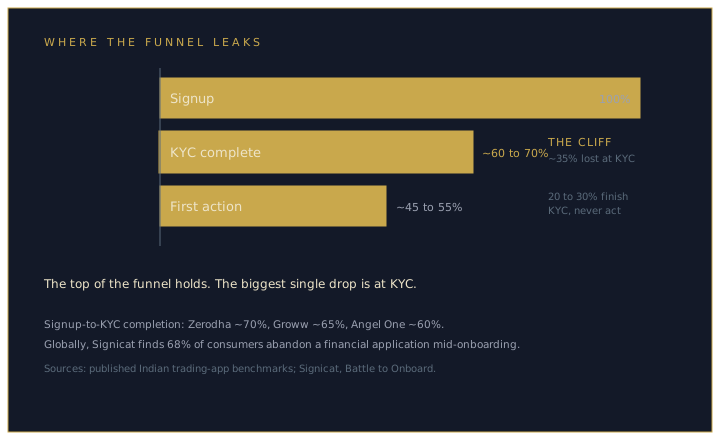
In the Indian context, the trading-app numbers are the clearest picture I have seen. Published account-opening benchmarks put signup-to-KYC completion at roughly 70 percent for Zerodha, 65 percent for Groww, and 60 percent for Angel One, with about 35 percent of users dropping off before they finish KYC. And the leak does not stop at verification: roughly 20 to 30 percent of users who complete KYC never place a first trade.
So the funnel breaks down roughly like this. Treat the top as healthy and the middle as the cliff:
Install to signup: usually healthy when the value proposition is clear.
Signup to KYC start: also usually fine, because the user is still motivated.
KYC start to KYC complete: this is the cliff. The best Indian apps land around 60 to 70 percent, which means a third or more of motivated users who started verification abandon it. Weaker funnels are far worse.
KYC complete to first action: another quiet leak, with 20 to 30 percent finishing KYC and then never taking the first real action.
Even the best Indian trading apps lose roughly a third of users at KYC, and another fifth to a third after KYC before the first trade.
That KYC-start-to-complete stage is where you should spend your effort, because a five point improvement there is worth more than a fifteen point improvement at the top of the funnel where you are already strong. Fix the constraint, not the loudest stage.
The three things breaking KYC
When you sit with session recordings and drop-off data, KYC abandonment almost always comes from three specific places.
Document upload friction. The user is asked to photograph a PAN card, an Aadhaar, sometimes a signature, often on a cramped form with unclear requirements. Each upload that fails or gets rejected for a blurry image is a moment the user can walk away, and many do.
Verification failures handled as dead ends. An OTP does not arrive. A name does not match across documents. The penny-drop bank verification fails. In a weak funnel the user hits a generic error and is simply stuck, with no clear way forward. That dead end is pure, avoidable loss.
The manual approval wait. The user finishes everything, then sees "your account is under review, please check back." That gap, sometimes hours, sometimes a day, is where intent dies. The user who was ready to fund the account in that moment is no longer in that moment when approval finally lands.
The fixes, in priority order
Here is the sequence I would run, highest leverage first.
1. Move KYC as late as you legally can. The single biggest lever. Let the user experience real value before you ask them to verify identity. Let them browse, build a watchlist, see a quote, simulate a portfolio, whatever your product allows pre-KYC under regulation. A user who has felt the value will push through KYC friction they would have abandoned cold. This one change, done well, has lifted KYC start-to-complete by double digits in my experience.
2. Cut the steps and fields to the legal minimum. Open your KYC flow and count the screens and fields. Then challenge every single one against the question: is this legally required right now, or are we collecting it because it is convenient for us later? Defer everything not strictly required to verify identity. Every removed field raises completion.
3. Pre-fill from DigiLocker and Aadhaar. Do not make the user type or photograph what you can fetch. DigiLocker, Aadhaar-based eKYC where permitted, and CKYC pulls turn a multi-minute typing-and-uploading ordeal into a few taps of consent. This attacks the document-upload friction directly.
4. Turn every failure into a recovery path. No dead ends. An OTP failure should offer resend, then call-based verification. A name mismatch should say exactly which fields differ and how to fix it. A failed bank verification should offer an alternate method. The goal is that no user can get permanently stuck, because every stuck user is a lost one.
5. Automate the approval path. For the common, clean case, approval should be instant and automated. Reserve manual review for genuine exceptions. If you cannot avoid a wait, do not leave the user idle: let them complete the next valuable step in parallel, so the wait is not a wall.
A simple diagnostic you can run this week
You do not need a big project to start. Run this:
Pull your funnel for the last 30 days as the four stages above, as rates not totals.
Find the stage with the biggest gap below the ranges in this piece. It will almost certainly be KYC start to complete.
For that stage, segment the drop-off by step. Where exactly inside KYC do they leave? Document upload? OTP? Post-submission wait?
Pick the single biggest sub-step and apply the matching fix above. Ship it. Measure for two weeks.
Then find the new constraint and repeat.
One stage, one fix, measured, then the next. That discipline is what turns a leaking funnel into a compounding one.
Why this is worth the effort
Acquisition is expensive and getting more so. Every user you lose at KYC is a user you already paid to acquire, walking out the door at the last step before they become valuable. Fixing onboarding is the highest-return growth work most fintech teams are not doing, because it is less visible than a new campaign and feels like someone else's job.
It is not. It is the difference between paying for users and keeping them. Move the KYC number and you improve every acquisition rupee you have already spent, with no increase in spend at all.
Frequently asked questions
Where do fintech onboarding funnels lose the most users?
Almost always at KYC. Signup to KYC-start is usually healthy, but KYC-start to KYC-complete is where the biggest single drop happens, often 30 to 50 percent of users who began. The leak concentrates at document upload, OTP and verification failures, and the wait for manual approval.
What is a good activation rate for a fintech app?
Measure activation as the percentage of signups who complete KYC and take one real action, like funding the account or placing a first order. Published Indian trading-app benchmarks put signup-to-KYC completion around 60 to 70 percent for the strongest players, but 20 to 30 percent of users who finish KYC still never take the first action. So a strong end-to-end activation rate, signup to first action, lands closer to 45 to 55 percent, and weaker funnels sit well below that. The gap is almost entirely KYC completion and time-to-first-action.
How do I reduce KYC drop-off?
Move KYC as late as possible so users see value first, reduce the steps and fields to the legal minimum, pre-fill from DigiLocker or Aadhaar where allowed, show clear progress, handle verification failures with specific recovery messages instead of dead ends, and remove any manual-approval wait by automating the common path.
Should KYC come before or after the user sees value?
After, wherever regulation allows. A user who has experienced the product will tolerate verification friction that a cold user abandons. The instinct to verify first, for cleanliness, is usually what is costing you the most users.
Sources: Signicat, Battle to Onboard (financial services onboarding abandonment); Fenergo (share of abandonment driven by KYC and AML documentation); published Indian trading-app account-opening benchmarks for Zerodha, Groww, and Angel One. Stage-level commentary also reflects my own work building these funnels in Indian fintech.
Piyush Wadhwa is a product and growth leader who has spent over a decade in fintech and D2C, including onboarding and KYC funnel work that scaled a trading platform from 0.2M to over 1.3M users at 5paisa. He advises founders on product, growth, and onboarding conversion, and is the author of "Overthinking Is Not a Superpower."