Most teams treat speed and thinking like a dial. Slide it toward speed and you ship more but make sloppier calls. Slide it toward thinking and you make better calls but ship less. Pick your poison.
I have spent over a decade inside product teams, and I can tell you the dial is a lie. Shipping more and thinking better are not opposites. They feed each other. The teams that ship the most are usually the ones thinking the clearest, and that is not a coincidence.
The reason the tradeoff feels real is that we have quietly confused a few words.
Key takeaways
Speed and thinking are not a tradeoff. Bad allocation of thinking is the real problem.
Most teams overthink the decisions that are cheap to reverse and underthink the few that are expensive to undo.
Good thinking makes shipping cheaper, because it settles the hard to reverse calls before they get expensive.
The operating rule: match how long you deliberate to how hard the decision is to undo.
The tradeoff that isn't
When people say "we don't have time to think, we need to ship," they usually do not mean thinking. They mean meetings. Decks. A debate that goes in circles for three days and ends exactly where it started. That is not thinking. That is theatre, and theatre genuinely does slow you down.
And when people say "move fast," they often mean skip the thought entirely. Just push it live and see. That works right up until you ship something you cannot easily take back.
So the felt tension is real. The diagnosis is wrong. You are not choosing between speed and thought. You are watching bad thinking dress up as caution, and recklessness dress up as speed.
Thinking is not overthinking
I wrote a whole book arguing that overthinking is not a superpower, so let me be precise about the difference here, because it is the whole game.
Overthinking is circling a decision without adding new information. You already know what you know. You are just feeling anxious about it on a loop.
Thinking is reducing uncertainty before it gets expensive. You go find the one fact that changes the call. You write down the assumption everyone is glossing over. You make the tradeoff explicit so the team can actually see it.
One is motion. The other is progress. Done right, thinking is the cheapest speed you can buy, because it stops you from shipping the wrong thing quickly and then spending a quarter quietly unwinding it.
The real problem is allocation
Here is the shift that fixes most of this.
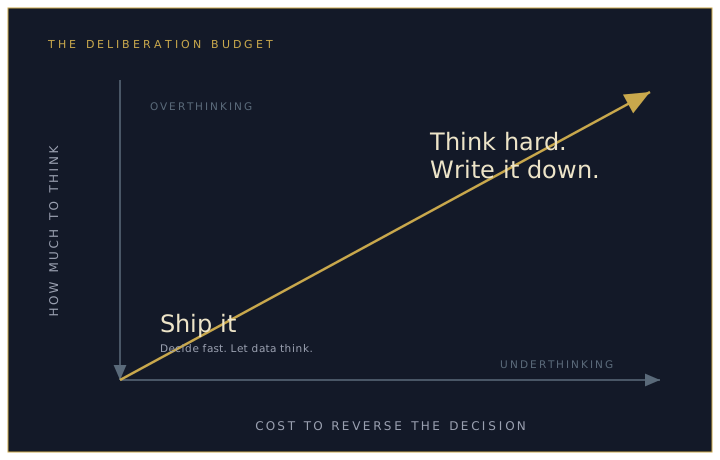
Every team has a fixed amount of careful thinking it can spend. Call it a deliberation budget. The mistake almost everyone makes is spreading that budget evenly across every decision, as if a button color and a billing platform deserve the same scrutiny.
They do not. The single best filter I know is this: how expensive is this decision to reverse?
Some decisions are two way doors. You walk through, and if it is wrong, you walk back out at almost no cost. A headline, an email subject line, a pricing experiment on five percent of traffic. For these, deliberation is waste. Decide quickly, ship, and let the data do the thinking for you.
Other decisions are one way doors. Re-platforming your checkout. Choosing a subscription billing vendor. Picking the core data schema your whole stack will sit on for three years. A brand repositioning. These are expensive, sometimes brutal, to undo. This is where your entire thinking budget should go.
Spend your thinking where reversal is expensive. The failure zones are the corners.
The failure mode is almost never too much thinking or too little. It is thinking applied to the wrong decisions.
What this looks like in practice
I see this constantly with D2C founders in the 10 to 150 crore range.
A team will spend three weeks debating the hero copy on the homepage, a change that takes an hour to make and an hour to undo. Then the same team will spend thirty minutes choosing the subscription billing system they will be married to for the next three years, picking whatever the first sales call recommended.
That is the allocation problem in one sentence. Three weeks on the two way door, thirty minutes on the one way door. Flip it.
The fast looking teams are not skipping thought. They have just moved their thinking to the places where being wrong is expensive, and they default to action everywhere else.
How to make this a habit
You do not need a framework deck for this. You need one question, asked before every decision of any size:
If this turns out to be wrong, how expensive is it to undo?
Cheap to undo? Decide now. Ship it. You will learn more from the live version in a week than from another meeting.
Expensive to undo? That is your signal to slow down, find the missing information, and write down the reasoning. Writing matters here for two reasons. It forces the fuzzy thinking into the open, and it makes the decision reusable, so the next person does not have to relitigate it from scratch.
And remember that shipping is itself a thinking tool. A shipped experiment teaches you more than ten arguments about what users might do. So speed is not the enemy of thought. For the reversible majority of your decisions, speed is how you think.
The teams that look fast from the outside are usually just thinking in the right places. Shipping more and thinking better are the same skill wearing two different outfits.
Frequently asked questions
Does thinking more slow you down?
Not if you spend it on the right decisions. Thinking on a reversible decision is waste and does slow you down. Thinking on an expensive, hard to reverse decision is what stops you from losing a quarter to a bad call. The skill is knowing which is which.
How do I know if a decision is reversible?
Ask what it costs to undo it: time, money, trust, and momentum. If you can walk it back in a day with no lasting damage, treat it as reversible and decide fast. If undoing it means re-platforming, re-hiring, or re-launching, treat it as expensive and think hard.
Isn't this just "move fast and break things"?
No. Move fast on the things that are cheap to break. Move carefully on the things that break expensively. The original slogan skips that distinction, which is why it works for some startups and quietly destroys others.
What is the difference between thinking and overthinking?
Overthinking is going over a decision again without any new information. Thinking is going to find the information that actually changes the decision. One loops, the other moves.
Piyush Wadhwa is a product and growth leader who has scaled platforms from 0.2M to over 1.3M users across fintech and D2C, including as Head of Product at SleepyCat. He now advises consumer and D2C founders on product, growth, and decision making, and is the author of "Overthinking Is Not a Superpower."